

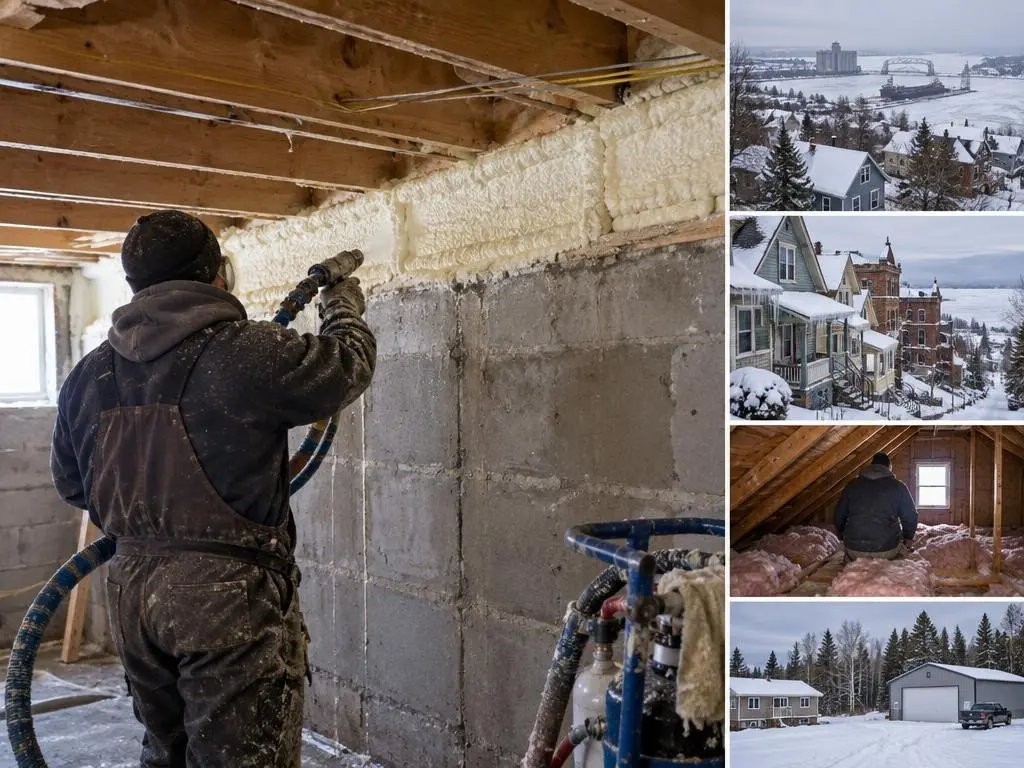
Hillside houses, lake wind, 90 inches of snow
Spray Foam Insulation in Duluth, MN
Many Duluth homes are over 80 years old. We insulate them for the winters they actually get.
- Free on-site estimates
- Written quote showing material, thickness and R-value for each area
- Attics, rim joists and basements checked for moisture before anything is covered
A City of Old Houses on a Steep Hill
Spray foam insulation in Duluth starts with the age of the houses. The city's 2020-2024 consolidated plan housing analysis reports that about 44 percent of Duluth's housing was built before 1940, compared with well under a fifth statewide, and that more than half of owner-occupied homes predate 1950. Those houses went up before modern air sealing, and most leak heat at the rim joist, the attic floor and through hollow walls.
What the winters ask of a house
Duluth's 1991-2020 normals show a January mean of 11.2F, an average January low of 2.4F and about 90 inches of snow a year. Upslope lake-effect storms can drop a foot or more at once. Minnesota's energy rule sizes heating systems in Duluth for a -20F design temperature. Every leak in an old house works hard under those numbers.
The hillside
The city climbs steeply from the lake to the heights above it, and many houses have tall foundation walls on the downhill side, walkout basements and exposed rim joists. Those are prime spots for closed-cell foam. Up top in Piedmont Heights, Bayview Heights and along the ridge, wind exposure adds to the heat loss.
Company-town and workers' housing
Neighborhoods like Riverside were built to house shipyard workers, and Morgan Park was built by U.S. Steel after 1907 as a planned company town. Houses from those eras are often modest in size with simple attics, which makes attic air sealing and blown-in insulation an affordable first step.
Where we usually start
In a typical older Duluth house: seal and insulate the rim joist with closed-cell foam, air seal the attic and blow it up to Zone 7 depth, then look at walls if rooms stay cold. Get a free estimate
Duluth Facts That Shape Insulation
- Housing age. The City of Duluth's 2020-2024 consolidated plan housing market analysis reports that about 44% of the city's housing was built before 1940 (2019 ACS), and 52% of owner-occupied units before 1950.
- Winter climate. Duluth's 1991-2020 normals list a January daily mean of 11.2F, an average January low of 2.4F, a record low of -41F and about 90.2 inches of snow per year.
- Design temperature. Minnesota Rule 1322.0403, Table R403.5.17, lists a winter design dry-bulb temperature of -20F for Duluth.
- Climate zone and frost. St. Louis County is in IECC Climate Zone 7 (R-49 ceilings in the 2012 IECC table) and in Minnesota frost Zone I, with a 5-foot minimum footing depth.
- Housing count. The 2020 census counted 39,762 housing units in Duluth, 6.7% of them vacant.
Duluth Questions
Where does an old Duluth house lose the most heat?
Usually the attic floor and the rim joist, then hollow exterior walls. Sealing those three areas covers most of the leakage in a pre-1940 house.
Can you foam a stone or block foundation in Duluth?
Yes, if it is dry. Closed-cell foam follows uneven stone and block. We check for water first.
What R-value should a Duluth attic reach?
R-49 is the Zone 7 ceiling value in the 2012 IECC table; DOE recommends R-60 when starting from little insulation.
Do you work in all Duluth neighborhoods?
Yes, from Fond du Lac and Morgan Park to Lakeside and Duluth Heights.
Free Estimates in Duluth, MN
Old house or new, we will look at it and quote it in writing.
Spray Foam Insulation Near Duluth
- Spray Foam Insulation in Superior, WI
- Spray Foam Insulation in Hermantown, MN
- Spray Foam Insulation in Proctor, MN
- Spray Foam Insulation in Cloquet, MN
- Spray Foam Insulation in Esko, MN
- Spray Foam Insulation in Scanlon, MN
- Spray Foam Insulation in Carlton, MN
- Spray Foam Insulation in Two Harbors, MN
- Spray Foam Insulation in Rice Lake, MN
- Spray Foam Insulation in Knife River, MN
- Spray Foam Insulation in Wrenshall, MN